
HIPAA Document Scanning in Arizona
- HIPAA-focused scanning processes for healthcare records and PHI in Arizona
- Controlled handling procedures intended to protect patient privacy during conversion
- High-quality digitization with searchable PDF and indexing options
- Documented chain-of-custody from intake through secure file delivery
- Designed for physician groups, ambulatory surgery centers, and other care-delivery organizations
- Flat-rate planning per standard document box when applicable
- Request your FREE QUOTE today

Secure, Searchable Healthcare Records in Arizona
Liberty Scanning provides secure medical-record digitization for organizations across Arizona. We convert paper charts, patient-level records, administrative documents, and archives into organized digital files using managed workflows intended to safeguard protected healthcare information during the digitization engagement.
Our services support physician groups, ambulatory surgery centers, rehabilitation providers, healthcare administrators, and other organizations that handle sensitive healthcare information. Projects can range from selected inactive files to full record-room conversions.
Quick answer: HIPAA document scanning is the controlled conversion of physical health records into digital files using administrative, physical, and technical safeguards appropriate to the engagement. Scanning can support a compliance program, but it does not by itself make an organization compliant; each customer remains responsible for its legal, access, retention, and disclosure decisions.
What We Scan
Liberty Scanning handles healthcare record collections that require careful organization, restricted access, and documented processing. The exact record categories and retrieval fields are defined with the customer before capture begins.
- Patient charts and inactive medical files
- Intake, consent, and registration forms
- Billing, insurance, and administrative documents
- Laboratory and diagnostic reports
- Clinical correspondence and referral documents
- Behavioral health and specialty-practice files
- Mixed-size healthcare records and archive boxes
- Customer-defined healthcare record series
How We Scan
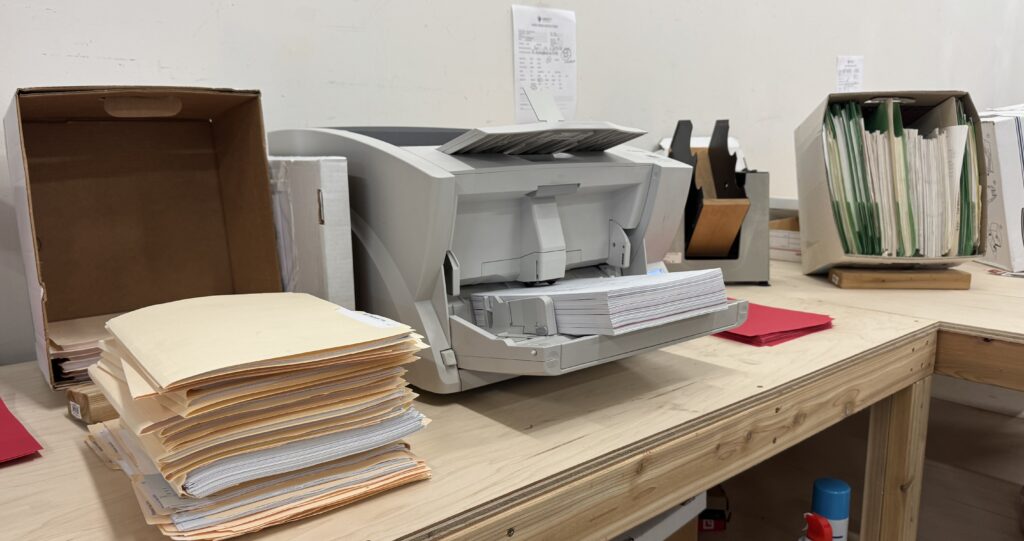
The workflow is planned around record type, sensitivity, organization, and client-authorized output. Liberty Scanning uses in-house digitization and controlled project steps through intake, capture, and handoff.

- Documented intake and chain-of-custody tracking
- Restricted project access and trained scanning staff
- High-speed capture for supported batches of healthcare files
- Flatbed and specialty scanning for fragile or mixed-size documents
- OCR-enabled searchable PDF options
- Customer-approved indexing, naming, and folder structure
- Image verification and exception review
- Optional upload to Liberty Cloud
HIPAA Scanning with Liberty in Arizona
Liberty Scanning’s processes are designed for projects involving PHI and sensitive healthcare information. The company uses trained staff, controlled facilities and workflows, documented handling, and fully in-house digitization work.
- HIPAA-focused safeguards and restricted project access
- Trained staff and fully in-house digitization work
- Conversion from individual files to full archives
- Searchable PDF and indexing options
- Large-format and specialty scanning when needed
- Documented tracking and verification procedures
- Secure secure file delivery options
- Flat-rate per-standard-document-box pricing when applicable

Learn more about Liberty Scanning’s HIPAA-focused processes, no-outsourcing policy, and broader healthcare scanning services. Customers should determine which federal, state, contractual, and retention requirements apply to their records and operations.
Planning a Healthcare Records Project in Arizona
Scoping a Phoenix healthcare archive
healthcare administrators in Phoenix may prioritize patient identifiers and date ranges, while records from Tucson may be grouped by practice, provider, or service line. Reviewing those differences early produces a clearer inventory and a more useful secure file delivery.
Protecting context during Mesa scanning
Files from Mesa may rely on folder labels, separators, and sequence to preserve meaning. The scanning plan can retain customer-defined record boundaries, apply approved naming, and document exceptions for review rather than silently guessing at ambiguous content.
Connecting Chandler and Scottsdale workflows
When teams in Chandler and Scottsdale use different conventions, an agreed crosswalk can standardize digital names while preserving source references. This helps authorized personnel recognize the files without requiring every location to abandon familiar terminology.
Long-term retrieval across Arizona
Records associated with Glendale, Tempe, or Flagstaff may be needed for operations, audits, continuity, or authorized patient requests. Searchable files and a consistent folder structure can improve retrieval, but each organization remains responsible for access policy, retention, disclosure, and compliance decisions.
Indexing records for Phoenix and Tucson
physician groups in Phoenix may rely on patient and date identifiers, while ambulatory surgery centers in Tucson may organize files by program, location, or provider. The approved index can preserve those differences instead of forcing unrelated record sets into a single pattern. Representative folders help confirm which fields are dependable before capture begins.
Reviewing OCR needs near Mesa
A Mesa records team may want keyword search for typed forms, but handwritten notes and low-contrast originals will not behave like clean machine text. OCR expectations can be documented by record category, and image quality remains the primary reference when text recognition is incomplete. This distinction helps authorized Arizona users understand the delivered files.
Separating active and inactive files in Chandler
rehabilitation providers near Chandler may need active charts separated from inactive archives or administrative documents. Customer-defined preparation rules identify which groups belong together, which separators carry meaning, and which exceptions require review. Liberty Scanning applies those approved instructions without making clinical, retention, or disclosure decisions for the organization.
Planning delivery for Scottsdale staff
Authorized users in Scottsdale may need patient-level PDFs, department folders, date-based groups, or another established structure. The delivery plan can also define encryption, transfer method, media, or an approved cloud destination. The customer remains responsible for downstream permissions and system configuration after the files leave the controlled scanning workflow.
Coordinating a multisite project in Glendale
When healthcare administrators operate in Glendale and Tempe, each location may label files differently. A client-authorized crosswalk can retain source references while applying a consistent Arizona digital convention. Intake logs and production tracking help keep locations distinguishable even when the final archive is designed for centralized access.
Handling exceptions from Flagstaff
Files associated with Flagstaff may include torn pages, loose inserts, unusual sizes, missing labels, or documents that do not match the expected record series. A documented exception path keeps those items visible for authorized review. The project does not infer missing patient data or silently reclassify ambiguous healthcare content.
Supporting a defensible Arizona workflow
For records connected to Phoenix, Mesa, Scottsdale, and Tempe, a repeatable workflow is easier to review than informal one-off handling. Documented intake, restricted access, approved naming, capture review, exception reporting, and secure delivery create an auditable project history while leaving policy and compliance judgments with the accountable healthcare entity.
Setting access expectations before scanning
The accountable healthcare entity decides which workforce members may receive or use the finished files. Liberty Scanning can deliver the agreed electronic organization, but access roles, disclosures, retention periods, and downstream system permissions remain customer decisions.
Keeping scope and pricing straightforward
Once record volume and project requirements are reviewed, Liberty Scanning provides clear flat-rate pricing per standard document box when applicable. The quote defines the agreed scope without publishing internal rates or asking the customer to estimate every production step.
Designed for Secure and Efficient Retrieval
Paper archives can slow authorized retrieval and require repeated handling of sensitive originals. Searchable, consistently named digital files can help approved staff locate information more efficiently while the healthcare organization maintains responsibility for permissions, disclosure rules, retention, and system security.
A strong project plan identifies record boundaries, naming conventions, OCR needs, exception handling, quality review, and delivery before scanning starts. This reduces ambiguity and makes the resulting archive easier to audit and maintain.
HIPAA Scanning Across Arizona
Liberty Scanning coordinates medical-record digitization projects throughout Arizona. Common service areas include Phoenix, Tucson, Mesa, Chandler, Scottsdale, Glendale, Tempe, Flagstaff, along with nearby communities and statewide organizations.
Phoenix
Tucson
Mesa
Chandler
Scottsdale
Glendale
Tempe
Flagstaff
Related Southwest State Pages
Get Started with a Free Quote
Tell Liberty Scanning what records you have, where they are located, and how authorized personnel need the digital files organized. We will review the scope and provide a free project estimate with simple clear flat-rate pricing per standard document box when applicable. Request a quote online or contact us.
Partner with Liberty Scanning



Looking for reliable shredding, scanning, records storage, media conversion, or cloud services? Contact Liberty for a free, no-obligation quote and help selecting the right solution.
HIPAA Document Scanning FAQ
What is HIPAA document scanning in Arizona?
HIPAA document scanning in Arizona is the controlled conversion of physical health records into digital files using safeguards intended to protect PHI during intake, scanning, quality review, and delivery.
Which healthcare records can be scanned?
Projects may include patient charts, intake forms, billing and insurance documents, lab reports, administrative documents, inactive files, and full healthcare archives.
Can scanned records be searchable?
Yes. OCR can create searchable PDF files, and client-authorized indexing can organize documents by fields such as patient identifier, date range, department, record series, or another supplied convention.
How are sensitive healthcare records protected?
Liberty Scanning uses restricted access, documented chain-of-custody procedures, trained staff, in-house digitization, quality control, and secure project delivery. Customers determine their own access, retention, disclosure, and compliance requirements.
Can you coordinate HIPAA scanning projects across Arizona?
Yes. Liberty Scanning coordinates medical-record digitization projects across Arizona, including Phoenix, Tucson, Mesa, Chandler, Scottsdale, and surrounding communities.
How is pricing handled?
Liberty Scanning keeps planning straightforward with clear flat-rate pricing per standard document box when applicable. Contact us for a free project estimate based on the agreed scope and delivery needs.